Yeongjong Grand Bridge
Road and Railway Korea
1995.11.01 ~ 2000.11.01
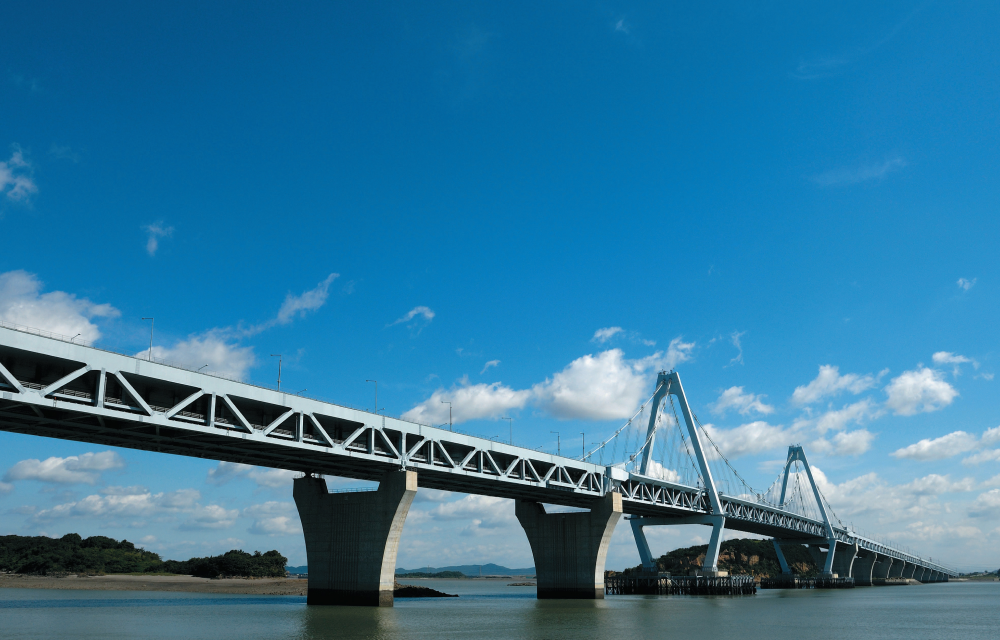
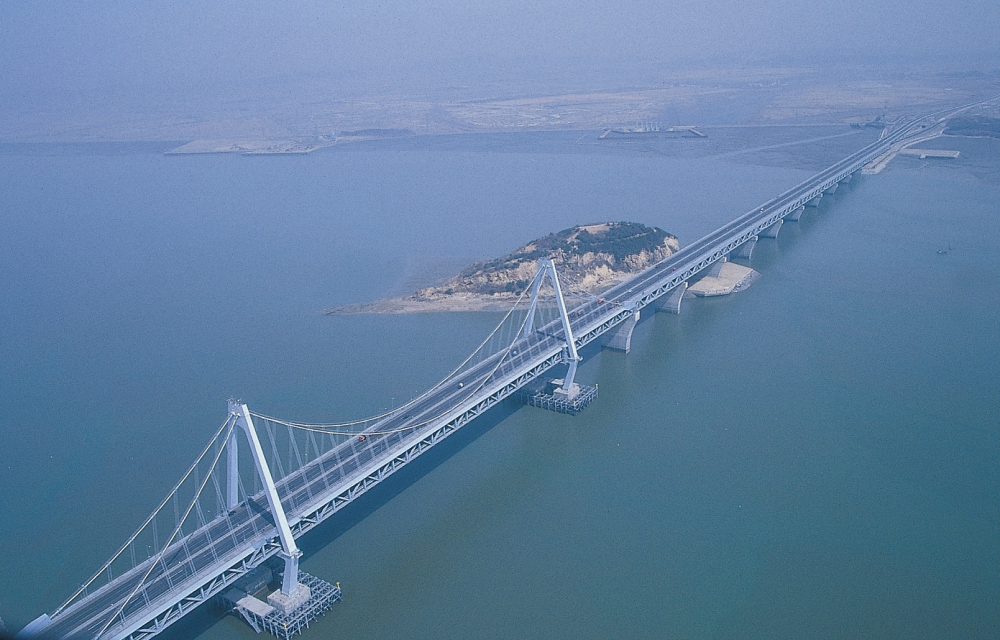
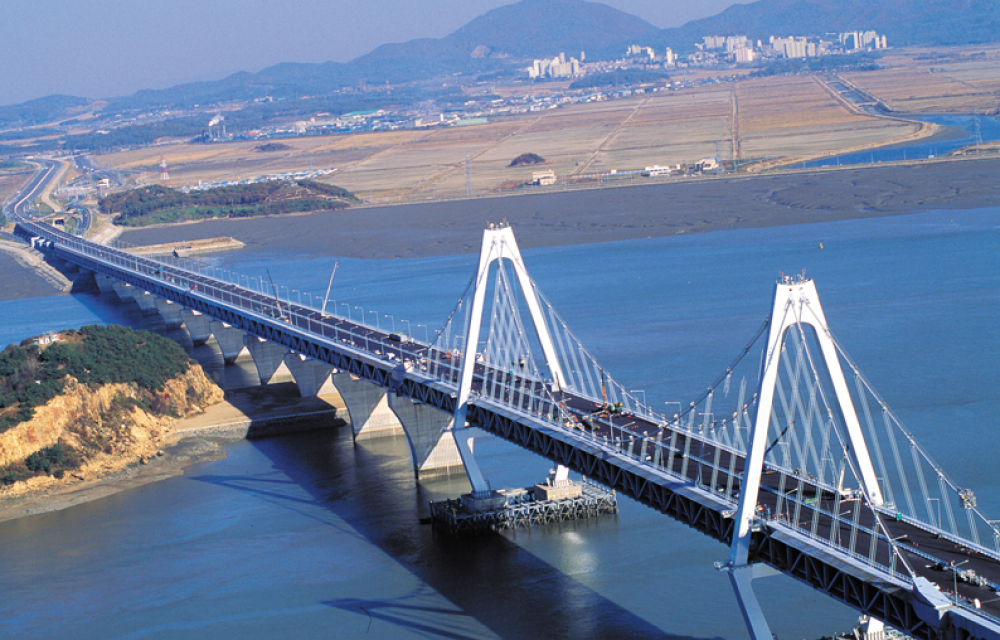
Feature: 2002 Tanaka Awards (Japan Society of Civil Engineers)
Decription: First-Ever Self-Anchored Suspension Bridge with 3-Dimensional Cable
[Road/Bridge]
The Yeongjong Grand Bridge is the world's first 3-dimensional self-anchored suspension bridge. The two-level bridge is 4,420 meters long (2.7 mile). The upper level is a six-lane road, while the lower level consists of a four-lane road and a double-track railroad.
To construct the bridge two unique construction methods were applied on the project:
1) Strong tides, reaching 2.5 meters per second (5.5 miles per hour), and the rise and fall of the tides reaching 8.5 meters (nearly 28 feet) had a strong impact on construction activities. To meet the accelerated schedule, Samsung used the Pneumatic Caisson method, a first in Korea, to lay the groundwork to erect pillars. Workers were able to excavate up to 96 tons of soil per day, resulting in the pillar erection being completed three months earlier than scheduled.
2) Due to a lack of space to construct the bridge's main tower, weighing 27,000 tons, trusses, and other bridge elements were delayed. To mitigate the impacts caused by the delays, Samsung used large block erection methods, utilizing a 3,000-ton crane, to bring the project back on schedule. The 107 m-high (350 feet) main tower was divided into three blocks (one block weighs about 1,200 tons), and then installed. The truss of the self-anchored suspension part was divided into eight blocks (one block weighs 1,200 tons. It is 70 meters (229 feet) long, 35 meters wide (115 feet) and 12 meters (39 feet) high on average) and then produced.
A distinguishing feature of the suspension bridge is its layout of the main cable. Three-dimensional cables were applied to construction of a bridge for the first time in the world. The main cables take 3-dimensional shapes. As the main cables are away the main towers to the middle of the center span or the anchorage, the distance between the cables increases. The hangers that connect the upper deck of the stiffening truss to the main cables are inclined in the transverse axis due to 3-dimensional main cable layout. The bridge is capable of resisting environmental factors including hurricanes and earthquakes over its 100-year life span - the bridge is capable of resisting winds up to 145 miles-per-hour and earthquakes measuring 6 on the Richter scale.
- DESIGN &; BUILD
- TOTAL LENGTH : 2.05 km
- WIDTH : 40 m(DOUBLE DECK)
- AIR SPINNING METHOD
- LARGE BLOCK CONSTRUCTION METHOD
- SUSPENSION BRIDGE 550 m + TRUSS BRIDGE 1,500 m
- UPPER DECK : ROAD 6 LANES
- LOWER DECK : ROAD 4 LANES, RAILWAY DOUBLE TRACKS
- DIAMETER OF WIRE : 5.1 mm
- ANALYSIS OF GEOMETRY CONTROL WITH SISCAB PROGRAM
- ERECTION WEIGHT 2,750~2,950 TONS(8 LARGE BLOCKS)
